5.1 The Problem of Assessment
The probabilistic assessment of an FT consists of calculating the probability of a top event starting from the probabilities of the basic events. This can be done directly when the FT does not possess any repeated event. This is carried out with a simple approach, which consists of climbing back up the FT by starting from its primary operators up to the top event.
When the FT possesses repeated events, the calculation as mentioned above is no longer applicable (it yields over-evaluated results). For exact calculation in this case, we should pass through minimal sets of the FT and then use one of the methods presented in Chapter 2; that is, the inclusion-exclusion development or the disjoint products or factorization. In Chapter 9, we will give a more recent method based on binary decision diagrams.
Because of the high reliability of the majority of the systems, the inclusion-exclusion development is the most commonly used, as the second term only yields highly satisfactory results.
Two families of problems, from the viewpoint of the probabilistic assessment, are usually raised.
Problem 1: non-repairable systems.
For these systems, we have: R( t) = A( t) = 1 - P S( t), for all t ? 0. The second equality is valid in the case of binary systems. In the opposite case, we have to replace P S( t) with 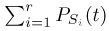 where S i, i = 1,

 TABLE OF CONTENTS