4.1 Introduction
When the construction of an FT is over, it can be analyzed from an algebraic point of view (this analysis is also called logical or even qualitative analysis); that is, we have to determine the structure function (or indicator function) of the FT concerning the top event, or, generally, any intermediate event. The determination of the structure function involves the study of minimal sets, that is, minimal cut sets and minimal path sets.
It has to be noted that the structure function is the indicator function of the top event of the FT; that is, it takes up the value 1 for the occurrence of the top event, and the value 0 for its non-occurrence. In a binary system, the top event of the FT translates the failure of the system, and consequently the structure function takes up the value 1 when the system has broken down. This is contrary to the convention in Chapter 2.
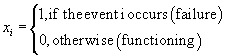
The construction and reduction of the structure function of the FT is the most significant in this analysis. The structure function of an FT will be dual in comparison with the FT given in Chapter 2, with an inversion of the convention adopted, i.e.:
For all values of i ? ?:
Same convention for the structure function:
We admit that the FT contains:
In other words, the FT is coherent.
A basic event is said to be relevant or essential

 TABLE OF CONTENTS