Fundamentals of Electromagnetics with MATLAB, Second Edition
Chapter 5: Time-Varying Electromagnetic Fields

The subject of time-varying electromagnetic fields will be the central theme throughout the remainder of this text. Here and in the following chapters we will generalize to the time-varying case the static electric and magnetic fields that were reviewed in Chapter 2 and Chapter 3. In doing this, we must first appreciate the insight of the great nineteenth century theoretical physicist James Clerk Maxwell who was able to write down a set of equations that described electromagnetic fields. These equations have survived unblemished for almost two centuries of experimental and theoretical questioning. The equations are now considered to be on an equal footing with the equations of Isaac Newton and many of Albert Einstein's thoughts on relativity. [1] We will concern ourselves here and now with what was uncovered and explained at the time of Maxwell's life.

5.1 Faraday's Law of Induction

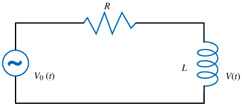
The first time-varying electromagnetic phenomenon that usually is encountered in an introductory course dedicated to the study of time-varying electrical circuits is the determination of the electric potential across an inductor that is inserted in an electrical circuit. A simple circuit that exhibits this effect is shown in Figure 5-1.


Figure 5-1: A simple electrical circuit consisting of an AC voltage source V 0( t), an inductor, and a resistor. The voltage across the inductor is V( t).

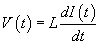
The voltage across the inductor is expressed with the equation

(5.1)

where L is the inductance, the units of which are henries, V(

UNLIMITED FREE
ACCESS
TO THE WORLD'S BEST IDEAS

SUBMIT
Already a GlobalSpec user? Log in.

This is embarrasing...

An error occurred while processing the form. Please try again in a few minutes.

Customize Your GlobalSpec Experience

Category: Inductance Standards and Decades
Finish!
Privacy Policy

This is embarrasing...

An error occurred while processing the form. Please try again in a few minutes.