Fundamentals of Electromagnetics with MATLAB, Second Edition

The study of electromagnetic wave propagation is based on the ideas of the great nineteenth-century theoretical physicist, James Clerk Maxwell. He was able to describe time-varying electromagnetic fields with four equations from which we derive the wave equation. Electromagnetic waves which are the solutions of this equation propagate with the velocity of light.
The fact that Maxwell's equations serve as the point of embarkation for our study of electromagnetic waves should not be too surprising since the explanations for all phenomena in electromagnetic theory trace their origins to the same four equations.
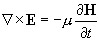
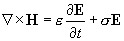
The wave equation we will initially derive describes wave propagation in a homogeneous medium that could have losses. In our derivation, there will be no free charge density, hence ? v = 0, because we are interested here in electromagnetc fields outside the "source region." Therefore, Maxwell's equations are written as
| (6.1) | |
| (6.2) | |
| (6.3) | |
| (6.4) | |
where we have incorporated the constitutive relations
| (6.5) | |
to eliminate the terms D, B, and J. In (6.2) we assume there are no external currents. All electromagnetic fields explicitly depend on space and time, i.e., E = E( r, t) and H = H( r, t). As we will see later, the two equations involving the divergence operation can be used to specify the value of a certain term in a vector identity, and we will initially manipulate the two equations that contain the curl operation. Also, we recall the...