The temporal and spatial evolution of the plasma adjacent to a metallic electrode whose voltage is suddenly decreased from zero to a large negative value has certain implications. A gaseous plasma consists of negatively charged electrons and positively charged ions whose mass is significantly greater than the mass of the electrons. In Example 6.3, we determined the potential profile at the time t = 0 + just after the switch connecting the negative potential source was closed at a time t = 0. During this initial time interval, the electrons were expelled from the region adjacent to the metallic plate but the ions had not yet started to move. The temporal and spatial evolution of these ions toward the negatively biased metallic electrode and the expansion of the ion density rarefaction into the plasma requires a numerical computation. [1] The plasma is modeled with a dimensionless-fluid-model description.
The ion density perturbation n i and the ion velocity perturbation v i are described with the equation of continuity
| (E.1) | 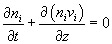
|
and the equation of motion
| (E.2) | 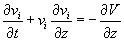
|
Since the mass of the electron is so much smaller than the mass of the ion, the electron density perturbation n e can be approximated with a Maxwell-Boltzmann distribution.
| (E.3) | 
|
In order to reflect the non-neutrality of the density perturbations, there will be an electric field E = - dV / dz that is governed by Poisson's equation
| (5.4) | 
|
These equations have been written in dimensionless...
Copyright SciTech Publishing, Inc. 2007 under license agreement with Books24x7


 TABLE OF CONTENTS