Geometric Concepts for Geometric Design
Technical and scientific illustrations are supposed to convey exact information as to the shape and size of certain objects. For this reason physical objects are most commonly represented by their projections into a plane using either parallel rays or a family of rays emanating from a center. While central projections can be realized physically by a camera, parallel projections can not. Regardless, both kinds of images can be constructed directly without a physical device. Moreover, one can reconstruct the shape and size of an object from a pair of such projections.
Although parallel projections cannot be realized physically, the concept of parallel rays has several advantages. Parallel projections are simple to construct and allow for an easy reconstruction of the measurements of an object from its image. Convincing examples of parallel projections include the military and cavalier projections which were first used by G. Monge (1746 1818) to construct scaled drawings of fortifications.
Literature: Hohenberg, Penna-Patterson, Rehbock
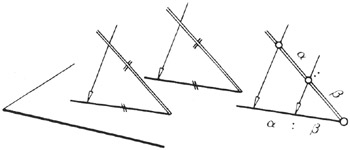
It is intriguing to observe that a parallel projection of two parallel lines produces a pair of parallel lines and that two parallel distances have the same ratio as their two parallel images. These properties, which are illustrated in Figure 4.1, are summarized in the fundamental theorem:
Parallel projections preserve parallelism and ratios.
On employing just these two simple...