Geometric Concepts for Geometric Design
Affine transformations map quadrics into quadrics, which means that affinely related quadrics have the same coordinate representations with respect to particular coordinate systems. As a result, there are only a finite number of affinely different types of quadrics in
. One can use the fact that midpoints, singular points, tangents, etc. are preserved under affine maps to construct coordinate systems with respect to which the equations of each type of quadric take on the same simple, so-called normal, form.
Literature: Berger, Blaschke, Samuel
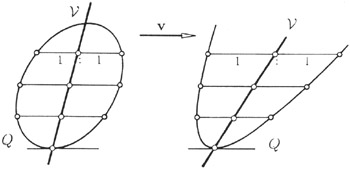
The midpoints of a family of parallel chords of a quadric Q lie in a plane. In order to prove this let the chords be represented by
The intersection points of one of these chords with Q are found by solving
where ? = v t C v, ? = [ C b + c] t v, and ? = Q( b). In particular, b is the midpoint of the chord if
which is a linear equation for b = x, concisely denoted as u t x+ u 0 = 0 and called the diametric plane of Q with respect to v. Examples are illustrated in Figure 14.1. A diametric plane
contains all midpoints of Q, i.e., one has
. Note that the diametric plane does not exist if v is axial, i.e., if C v = o.