Geometric Concepts for Geometric Design
The origin of differential geometry lies mainly in the works of Leonid Euler (1707 1783), Gaspard Monge (1746 1818) and his disciple Dupin (1784-1873), and Carl Friedrich Gauss (1777 1855). Quite different from the approaches taken in the previous chapters, classical differential geometry studies curves and surfaces only with regard to their local properties. Methods of using differential calculus concepts are investigated, including tangency, curvature, and contact of some order. A crucial tool is the use of a local coordinate system. An infinitesimally small change of this local system along the curve or surface is expressed in the initial system.
The properties obtained by a local analysis also lead to results about the global nature of curves and surfaces. Examples of global structures are lines of curvatures, geodesic nets, and isometric maps which leave measurements on a surface invariant.
In this chapter intrinsic properties of smooth curves in 3-dimensional Euclidean space, such as arc length, curvature, and torsion, are discussed. Then local properties of curves, particularly the contact of order r of two curves, are studied. The main tools for such investigations are the use of a local coordinate system and the Frenet-Serret formulas.
Literature: do Carmo, Guggenheimer, Haack, Nutbourne Martin
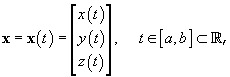
A parametric curve in ? 3 is given by
where x( t), y( t), z( t) are differentiable functions in t.