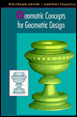
Geometric Concepts for Geometric Design
Parallelism is a characterizing concept of affine spaces. However, the fact that coplanar lines may or may not intersect gives rise to many special cases in affine geometry. Therefore, the invention of points at infinity by the French architect Girard Desargues (1591 1661) has lead to a unified approach and deeper insight into geometric structures. In the words of the English mathematician Arthur Cayley (1821 1895): "Projective geometry is all geometry."
In projective geometry, the points at infinity are not distinguished from the other points. This is the reason why projective geometry exhibits much more symmetry than affine geometry. With the introduction of homogeneous coordinates by Pl cker (1801 1868) it became possible to study projective geometry analytically. Barycentric coordinates are a specialization of homogeneous coordinates whose symmetry became apparent in the discussion of affine geometry in Part Three.
Homogeneous coordinates, which were introduced in Chapter 6, are the key to projective spaces. These coordinates can be viewed as generalized barycentric coordinates by suspending the condition that they form a partition of one.
Literature: Baker, Berger, Samuel, Wylie
Projective spaces can be viewed as extensions of affine spaces, as in Chapter 6. Then
= [ y 0 y t]represents the point
of some n-dimensional affine space
if y 0 ? 0, and it represents the direction of some line
in
if