Geometric Concepts for Geometric Design
Descriptive Geometry is concerned with the presentation of spatial objects in one or two planar projections and with the rules of generating such representations. It forms the theoretical basis of architectural and all technical drafting. Usually, an object is projected orthogonally into a pair of orthogonal planes which are in natural positions relative to the object. Such projections lend themselves to an easy reconstruction of the spatial object, and they allow one to draw any other projection of it.
By the methods of Descriptive Geometry, one also can construct the intersection of two surfaces as well as special curves and surfaces, such as a helix or a quadric. The methods of Descriptive Geometry go back more than two millenia, but it was the French mathematician Caspard Monge (1746 1818) who first systematized the many methods in use and who reduced them to a small number of simple principles.
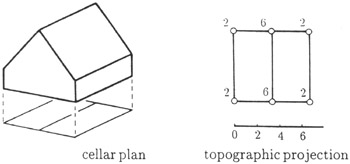
After projecting a spatial object into a plane, one dimension is lost. This loss can be compensated for by integrating, for example, the ground plan into the projection or by entering the heights into the plan, as illustrated in Figure 24.1. A more common approach, however, is to draw two orthogonal projections. Two such projections of a three-dimensional object are interrelated and facilitate the solutions to most kinds of construction problems.
Literature: Hohenberg, Koenderink, Leighton, Wunderlich
Consider an object...