High-Speed Circuit Board Signal Integrity
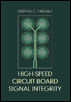
Filled with on-the-job-proven examples, this hands-on reference offers you the knowledge needed to quickly pinpoint transmission problems that can compromise your entire circuit design.
 TABLE OF CONTENTS
 Lossy transmission lines are the norm on circuit boards, especially when signaling over narrow trace at high frequencies, where skin effect and dielectric losses cause signal distortion. As we'll see in this chapter, at high frequencies the distortion is chiefly caused by unequal attenuation of the signal's harmonics, but phase distortion is the principal cause at lower frequencies. The attenuation is caused by losses due to the series resistance in the conductor and by shunt losses due to the dielectric. The calculations presented in the early sections lump these losses together and involve the use of complex numbers, but simplifications that avoid the use of imaginary numbers and separate out the resistive losses from the dielectric losses are later shown.
Although rectangular waveforms are usually of most interest to the digital circuit designer, the bulk of this chapter focuses on the treatment lossy lines give to sinusoids at single frequencies. This is appropriate because rectangular waves are made up of many single frequency harmonics, and the way each of those harmonics is treated as a pulse travels down a lossy line determines its final wave shape once it arrives at the load. The harmonics reassembly and the effect distorted pulses have on signaling is presented in Chapter 7.
This chapter begins by using ideas from circuit and network theory to analyze a lossy transmission line circuit model. This prepares the way for the discussion in Section 5.4 on traveling waves. The study of traveling waves can become mired...