High-Speed Circuit Board Signal Integrity
Filled with on-the-job-proven examples, this hands-on reference offers you the knowledge needed to quickly pinpoint transmission problems that can compromise your entire circuit design.
 TABLE OF CONTENTS
 Capacitors are ubiquitous on high-speed circuit boards, but design engineers often do not fully understand their electrical characteristics. This chapter discusses the operational behavior of surface mount ceramic capacitors in Section 10.2, and tantalum capacitors in Section 10.3. Through-hole devices and other capacitor types (such as metal film, mica, porcelain, or aluminum electrolytic) are not discussed.
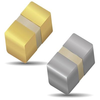
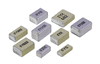
Surface mount technology (SMT) ceramic capacitors are comprised of multiple dielectric/electrode stacks fused together in a single package. Capacitors formed in this way are called multilayer ceramic chip (MLCC) capacitors. The number, size, and shape of the stacks are responsible for determining the capacitor's transient behavior, as they determine the equivalent series inductance (ESL) and equivalent series resistance (ESR). The choice of dielectric determines the capacitor's response to external effects such as mechanical shock, voltage bias (including the frequency response of that bias), and temperature. The dielectric material also has aging and ferroelectric characteristics, and its thickness determines the breakdown voltage, thereby setting the working voltage (WV) for a given capacitor.
As described in Chapter 3, the capacitance between two plates increases as the dielectric constant ? r increases. Manufactures use high ? r dielectrics to get as much capacitance as they can into the smallest possible SMT package. These dielectrics are ceramic blends that the Electronics Industries Association (EIA) has grouped into classes based on their temperature characteristic.
EIA specification 198 [1] defines a...