High-Speed Circuit Board Signal Integrity
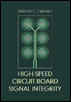
Filled with on-the-job-proven examples, this hands-on reference offers you the knowledge needed to quickly pinpoint transmission problems that can compromise your entire circuit design.
 TABLE OF CONTENTS
 Parallel bus signaling is ubiquitous on PWBs, and although loss effects are often not discussed, high-performance parallel bus signaling (such as source synchronous signaling) is amply described in the literature (for example, see [1] [4]). On the other hand, baseband serial transmission (where a serial data stream is transmitted without modulation) is not as well covered in the signal integrity literature. This type of signaling is becoming increasingly popular as integrated circuit technology permits the production of reliable and repeatable serial transmitters and receivers capable of multigigabit-per-second data rates. This technology is widely used for signaling across long backplanes and cables and is now becoming mainstream enough to gain acceptance as a way to signal locally between ASICs collocated on a PWB.
In this chapter, we discuss baseband serial signaling, with an emphasis on the effects loss has on signal quality. Although this chapter explicitly focuses on serial transmission, the discussion of harmonics and distortion is equally relevant to the lines within a parallel data bus.
The chapter begins with the briefest possible review of Fourier analysis and shows the relationship between spectral content and pulse characteristics. Line and block codes are next discussed in the context of the frequency content of a data stream, and ISI (the bane of high-speed serial or parallel signaling) is introduced. Eye diagrams as a diagnostic tool naturally follow. Equalization and preemphasis (essential for serial transmission at gigabit-per-second rates) are examined next, which leads into the use of ac coupling...