High-Speed Circuit Board Signal Integrity
Filled with on-the-job-proven examples, this hands-on reference offers you the knowledge needed to quickly pinpoint transmission problems that can compromise your entire circuit design.
 TABLE OF CONTENTS
 Differential signaling using two wires to simultaneously send the true and complement versions of a signal is a commonly used high-speed interconnect technique. Although it requires twice as many wires, when properly implemented, differential signaling has better noise immunity than single-ended signaling (i.e., signals referenced to a voltage assumed to be common between the transmitter and receiver, such as ground or a reference voltage). In fact, a characteristic of differential signaling is that it allows proper reception even when the transmitter and receiver grounds are not at the same voltage. This has great advantage when signaling across long cables or between cards plugged into a backplane because in both cases there will be a voltage difference between the transmitter and receiver local grounds. And, in both cases crosstalk between signals or noise coupled in from the return path will alter the switching levels, degrading performance. To a certain extent, differential signaling is immune to both of these effects, as discussed next.
Differential signaling uses a differential transmitter and differential receiver arraigned as shown in Figure 8.13.
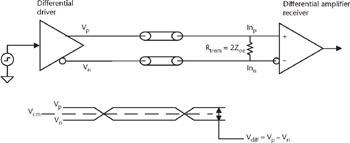
The transmitter simultaneously sends out voltages corresponding to a true and complement version of the input signal on the V p and V n wires, respectively. The signal is seen to swing above and below a common mode voltage V cm and has a differential voltage V diff that is the difference between...