Horizontal Well Technology

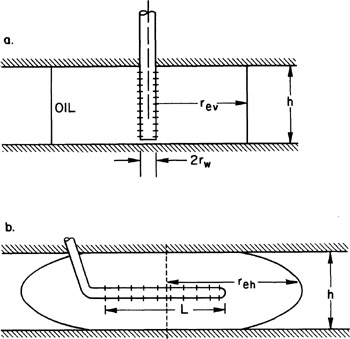
Figure 2-1 shows a drainage area for a vertical well and a horizontal well. A vertical well drains a cylindrical volume, whereas a horizontal well drains an ellipsoid, a three-dimensional ellipse. In general, we expect a horizontal well to drain a larger reservoir volume than a vertical well.
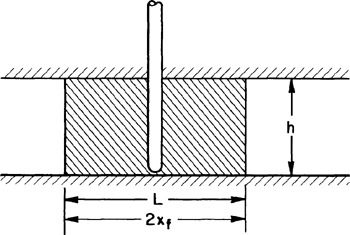
Figure 2-2 shows a fractured vertical well. The well is drilled in the reservoir of height h. The well is fractured and the fracture is fully penetrating, i.e., it covers the entire reservoir height. The fracture half-length is equal to x f. Moreover, we assume that the fracture has an infinite conductivity, which means that pressure drop within the fracture is negligible. In other words, pressure in the vertical wellbore and at every point within the fracture is the same. This represents an ideal or desired fracture for a vertical well. If the height of this fracture is reduced, one would obtain a horizontal well (see Fig. 2-3). A horizontal well represents a limiting case of an infinite-conductivity fracture where the fracture height is equal to the wellbore diameter. This also tells us that the hole diameter of a horizontal well would have an influence on its performance. For example, instead of drilling a 4 ? diameter hole, a 9 ?? hole is drilled; then the hole size has more than doubled. This increases the wellbore area open to the flow.