Horizontal Well Technology

VERTICAL WELL POST-WATER BREAKTHROUGH BEHAVIOR

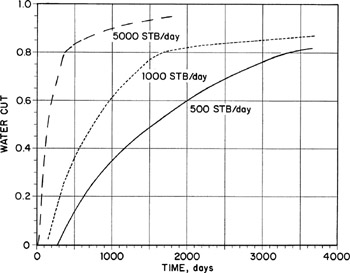
Presently, no simple analytical solution exists to calculate post-water breakthrough behavior of a vertical well. Normally, such a problem is solved using a numerical simulator. Several numerical studies have been reported in the literature. The majority of these studies are for homogeneous reservoirs with different vertical and horizontal permeabilities. (Theoretically speaking, there should be no water breakthrough problem if vertical permeability is zero.) Observation of these numerical results indicates that for a given homogeneous reservoir there is a unique relationship between water cut and percentage recovery of oil in place as shown in Figure 8-5. Regardless of the production rate, ultimate oil recovery is the same. As shown in Figure 8-6, high production rates result in high water cut at early times. According to Figure 8-5, which shows a unique relationship between water cut and recovery factors, high production rates facilitate high percentage oil recovery in a shorter time period. Because of this, under most coning situations, many operators use the most practical, high-volume artificial lift method to accelerate the oil production.


Figure 8-5: Water Cut versus Recovery Factor (Data from Example 8-6)

Figure 8-6: Variation in Water Cut over Time (Data from Example 8-6)

Kuo & DesBrisay [10] and Kuo [11] have correlated their numerical results to calculate water-cut behavior after breakthrough. Their correlations are summarized in Table 8-3. It is important to note that the correlation given in Table 8-3 was developed using straight line relative permeability curves. [10] [11]

EXAMPLE...

UNLIMITED FREE
ACCESS
TO THE WORLD'S BEST IDEAS

SUBMIT
Already a GlobalSpec user? Log in.

This is embarrasing...

An error occurred while processing the form. Please try again in a few minutes.

Customize Your GlobalSpec Experience

Category: Refining and Recovery Equipment
Finish!
Privacy Policy

This is embarrasing...

An error occurred while processing the form. Please try again in a few minutes.