Horizontal Well Technology

WATER AND GAS CONING IN HORIZONTAL WELLS

For a vertical well the majority of the pressure drawdown is consumed near the wellbore. Therefore, there is a big drawdown around the wellbore in a vertical well. In the case of horizontal wells, the pressure drop is fairly uniform throughout the reservoir, and in a small region near the wellbore, an extra pressure drop is observed. This pressure drop is, however, very small as compared to that around a vertical wellbore (see Fig. 8-1).

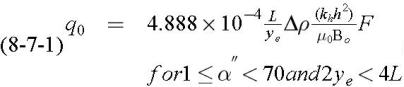
For horizontal wells, due to low-pressure drawdown, one expects a high oil production rate without coning. Various critical-rate correlations for horizontal wells are listed in Table 8-7. [4], [12] [15] In a reservoir with bottom water or top gas, rising water and downward movement of the gas cap can be controlled to obtain the best possible sweep of the reservoir. As shown in Figure 8-1, this is also called water cresting. With a proper operating procedure, the bottom water drive can behave similar to a waterflood from below, resulting in a very high recovery. (Some water drive reservoirs can give recoveries of the order of 60 to 65% of oil in place!)

TABLE 8-7: HORIZONTAL WELL CRITICAL RATE CORRELATIONS

Chaperon Method [4]


  • q 0 = critical rate, STB/day

  • L = horizontal well length, ft

  • y e = half drainage length (perpendicular to the horizontal well), ft

  • ?? = density difference, gm/cc

  • k h = horizontal permeability, md

  • h =...

UNLIMITED FREE
ACCESS
TO THE WORLD'S BEST IDEAS

SUBMIT
Already a GlobalSpec user? Log in.

This is embarrasing...

An error occurred while processing the form. Please try again in a few minutes.

Customize Your GlobalSpec Experience

Category: Artificial Lift Equipment
Finish!
Privacy Policy

This is embarrasing...

An error occurred while processing the form. Please try again in a few minutes.