Integrated Waterflood Asset Management

The need to enhance recovery from the vast amount of remaining oil and gas-in-place in the United States and elsewhere in the world, and the global competition requires better reservoir management practices. Historically, some form of reservoir management has been practiced when a major expenditure is planned, such as a new field development or waterflood installation. The reservoir management studies at these instances were not integrated, i.e., different disciplines did their own things separately. During the last 20 years, however, greater emphasis has been put on synergism between engineering and geosciences. Despite the emphasis, progress on integration has been slow.
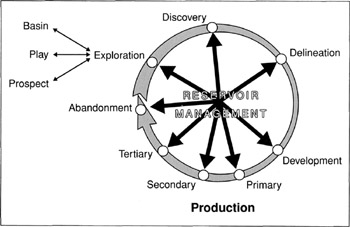
A reservoir's life begins with exploration leading to discovery followed by delineation of the reservoir, development of the field, production by primary, secondary and tertiary means, and finally to abandonment (Figure A-1). [1], [2] Integrated sound reservoir management is the key to successful operation throughout a reservoir's entire life.
This appendix provides:
Reservoir management definition
Reservoir management process
Synergy and team work
Organization and team management
Integration of geoscience and engineering
Reasons for failure of reservoir management program
[1]Satter, A. S., and Thakur, G. C. "Integrated Petroleum Reservoir Management: A Team Approach," PennWell Books, Tulsa, OK (1994).
[2]Satter, A., J. E. Varnon, and M.T. Hoang. "Integrated Reservoir Management," JPT (Dec 1994)
The goal or definition of reservoir management can be varied depending upon the political and/or economic environment in...