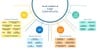
An efficient data management program consisting of acquisition, analysis, validating, storing and retrieving plays a key role in reservoir management. It requires planning, justification, prioritizing and timing.
Chapter 4 presents specific data required for waterflood asset management. This Appendix presents a general discussion of data types, data acquisition and analysis, data validation, data storing and retrieval, data applications, and examples.
Data Types [1], [02], [03]
Throughout the life of a reservoir, from exploration to abandonment, an enormous amount of multidisciplinary data are collected (see Table C-1). Also included in this table is the professionals responsible for acquisition and analyses. It is emphasized that the multidisciplinary professionals need to work as an integrated team to develop and implement an efficient data management program.
Table C-1: Reservoir Data | Life Cycle/Type | Data | Responsibility |
| Exploration | | |
| Seismic | Structure, stratigraphy, faults, bed thickness, fluids, interwell heterogeneity | Land men, geophysicists, seismologists |
| Geological | Depositional environment diagenesis, lithology, structure, faults, and fractures | Geologists |
| Discovery | | |
| Drilling | Mud, cuttings, geolograph | Drilling engineer, geologist |
| Logging | Depth, lithology, thickness, porosity, fluid saturation, gas/oil, water/oil and gas/water contacts | Development geologists, petrophysicists, and drilling engineers |
| Fluids (oil, water, and gas) | Formation volume factors, compressibilities, viscosities, solubilities, chemical compositions, phase behavior, and specific gravities | Reservoir engineers and laboratory analysts |
| Well Test | Reservoir pressure, effective permeability, thickness, presence of fractures or faults, productivity index | Reservoir and production engineers |
| Delineation | | |
| Coring | | Geologists, drilling and reservoir engineers, laboratory analysts |
| Basic | Depth, lithology, thickness, porosity, permeability, and residual fluid saturation | |
Copyright PennWell Corporation 1998 under license agreement with Books24x7


 TABLE OF CONTENTS