Integrated Waterflood Asset Management

Waterflood asset management requires economic evaluation of the project. Making a sound business decision requires that a project will be economically viable, i.e., it will generate profits satisfying the economic yardsticks of the company.
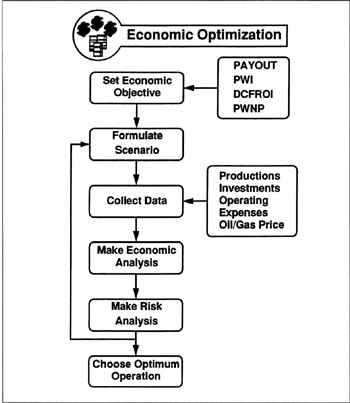
The tasks in project economic analysis (See Figure 11-1) require team efforts consisting of:
Setting economic objective based on company's economic criteria. Production and/or reservoir engineers are responsible for developing economic justification with the input from management
Formulating scenarios for project development. Engineers and geologists are primary contributors with management guidance
Collecting production, operation and economic data
Making economic calculations. Engineers and geologists are primarily responsible
Making risk analysis and choosing optimum project. Both engineers and geologists are primarily responsible for analysis. Engineers, geologists, operations staff, and management work together to decide on the optimum project
This chapter provides a review of commonly used economic criteria, and a working knowledge of analyzing project economics. [1] [6] The five cases considered for the example waterflood design problem presented in Chapter 7 were analyzed to determine the potentially most economically viable development plan.
[1]Satter, A., and G. C. Thakur. "Integrated Reservoir Management: A Team Approach," Penn Well Books, Tulsa, OK(1994)
[6]Hickman, T. S. "The Evaluation of Economic Forecasts and Risk Adjustments in Property Evaluation in the U.S.," JPT (February 1991) 220-25.
Making a sound business decision requires yardsticks for measuring the value of proposed investments and financial opportunities. Each...