Introduction to Airborne Radar, Second Edition
Chapter 7: Choice of Radio Frequency

Overview

A primary consideration in the design of virtually every radar is the frequency of the transmitted radio waves the radar's operating frequency. How close a radar may come to satisfying many of the requirements imposed on it detection range, angular resolution, doppler performance, size, weight, cost, etc. often hinges on the choice of radio frequency. This choice, in turn, has a major impact on many important aspects of the design and implementation of the radar.

In this chapter, we will survey the broad span of radio frequencies used by radars and examine the factors which determine the optimum choice of frequency for particular applications.

Frequencies Used for Radar

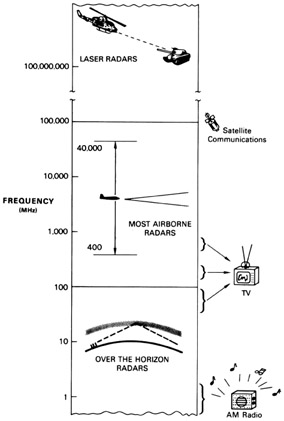
Today, radars of various kinds operate at frequencies ranging from as low as a few megahertz to as high as 300,000,000 megahertz (Fig. 1).


Figure 1: Portion of electromagnetic spectrum used for radar.

At the low end are a few highly specialized radars: sounders that measure the height of the ionosphere, as well as radars that take advantage of ionospheric reflection to see over the horizon and detect targets thousands of miles away.

At the high end are laser radars, which operate in the visible region of the spectrum and are used to provide the angular resolution needed for such tasks as measuring the ranges of individual targets on the battlefield.

Most radars, however, employ frequencies lying somewhere between a few hundred megahertz and 100,000 megahertz.

To make such large values more manageable, it is customary to express them in gigahertz. One gigahertz,...

UNLIMITED FREE
ACCESS
TO THE WORLD'S BEST IDEAS

SUBMIT
Already a GlobalSpec user? Log in.

This is embarrasing...

An error occurred while processing the form. Please try again in a few minutes.

Customize Your GlobalSpec Experience

Category: Aviation Transponders
Finish!
Privacy Policy

This is embarrasing...

An error occurred while processing the form. Please try again in a few minutes.