Introduction to Airborne Radar, Second Edition
Part VII: High-Resolution Ground Mapping & Imaging

Chapter List

Chapter 30: Meeting High Resolution Ground Mapping Requirements
Chapter 31: Principles of Synthetic Array (Aperture) Radar
Chapter 32: SAR Design Considerations
Chapter 33: SAR Operating Modes

Overview

An increasingly important airborne radar application is making radar maps of sufficiently fine resolution that topographic features and objects on the ground can be recognized.

In this chapter, we will learn how ground map resolution is defined and see what the optimum resolution is for various uses; then, review the approaches taken to providing it.

How Resolution Is Defined

The quality of the ground maps produced by a radar is gauged primarily by the ability of the radar to resolve closely spaced features of the terrain. This ability is generally defined in terms of resolution distance and cell size.

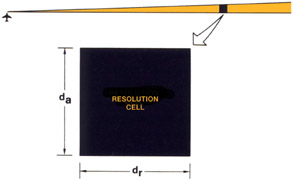
Resolution distance is the minimum distance by which two points on the ground may be separated and still be discerned individually by the radar. The separation is usually expressed in terms of a range component, d r, and an azimuth or cross range component, d a the component at right angles to the line of sight from the radar.

A resolution cell, or "pixel" (for picture element), [1] is a rectangle whose sides are d r and d a (Fig. 1). Because features of the terrain may be oriented in any direction, ideally d r and d a are equal, making the cell a square.


Figure 1: Resolution distance is the minimum distance...

UNLIMITED FREE
ACCESS
TO THE WORLD'S BEST IDEAS

SUBMIT
Already a GlobalSpec user? Log in.

This is embarrasing...

An error occurred while processing the form. Please try again in a few minutes.

Customize Your GlobalSpec Experience

Category: LiDAR Sensors
Finish!
Privacy Policy

This is embarrasing...

An error occurred while processing the form. Please try again in a few minutes.