Introduction to Airborne Radar, Second Edition
Electronically steered array antennas, ESAs, have been employed in surface based radars since the 1950s. [1] But, because of their greater complexity and cost, they have been slow to replace mechanically steered antennas in airborne applications.
However, with the advent of aircraft of extraordinarily low radar cross section and the pressing need for extreme beam agility, in recent years avionics designers have given the ESA more attention than virtually any other "advanced" radar concept.
In this chapter, we will briefly review the ESA concept, become acquainted with the two basic types of ESAs, and take stock of the ESAs many compelling advantages, as well as a couple of significant limitations.
[1]In surface-based radars, they were called "phased arrays" a name which has carried over to airborne applications. They are frequently called electronically "scanned," as opposed to "steered" arrays. In light of the versatility of the technique, the more general "steered" is used here.
An ESA differs from the conventional mechanically steered array antenna in two fundamental respects:
It is mounted in a fixed position on the aircraft structure
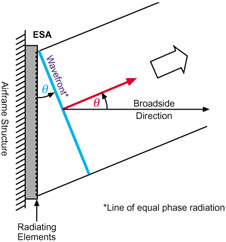
Its beam is steered by individually controlling the phase of the radio waves transmitted and received by each radiating element (Fig. 1)