Introduction to Airborne Radar, Second Edition

By far the most widely used method of range measurement is pulse delay ranging. It is simple and can be extremely accurate. But since there is no direct way of telling for sure which transmitted pulse a received echo belongs to, the measurements are, to varying degrees, ambiguous.
In this chapter, we will look at pulse delay ranging more closely learn how target ranges are actually measured and consider the nature of the ambiguities. We will see how ambiguities may be avoided at low PRFs, and resolved at higher PRFs. We will then consider ambiguities of a secondary type, called "ghosts," and see how these may be eliminated. Finally, we will look briefly at how range is measured during single-target tracking.
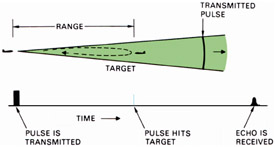
When a radar's transmission is pulsed, the range of a target can be directly determined by measuring the time between the transmission of each pulse and reception of the echo from the target (Fig. 1). The round-trip time is divided by two to obtain the time the pulse took to reach the target. This time, multiplied by the speed of light, is the target's range. Expressed mathematically,
where
| R | = range |
| c | = speed of light |
| t | = round-trip transit time |
A useful rule of thumb is 12.4 microseconds of round-trip transit time equals 1 nautical mile of range (Fig. 2). If you wish to calculate...