Introduction to Airborne Radar, Second Edition

Ideally, if we wanted both long detection range and fine range resolution, we would transmit extremely narrow pulses of exceptionally high peak power. But there are practical limits on the level of peak power one can use. To obtain long detection ranges at PRFs low enough for pulse delay ranging, fairly wide pulses must be transmitted.
One solution to this dilemma is pulse compression. That is, transmit internally modulated pulses of sufficient width to provide the necessary average power at a reasonable level of peak power; then, "compress" the received echoes by decoding their modulation.
This chapter explains the two most common methods of coding linear frequency modulation and binary phase modulation. It also briefly describes a third method, polyphase modulation. [1]
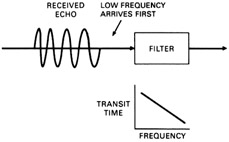
[1]All methods of pulse compression are essentially matched filtering schemes in which the transmitted pulses are coded and the received pulses are passed through a filter whose time-frequency characteristic is the conjugate (opposite) of the coding.
Because of its parallel to the chirping of a bird, this method of coding was called "chirp" by its inventors. Since it was the first pulse compression technique, some people still use the terms chirp and pulse compression synonymously.
With chirp, the radio frequency of each transmitted pulse is increased at a constant rate throughout its length (Fig. 1). Every echo, naturally, has the same linear increase in frequency.