Lubrication for Industry, Second Edition

Lubricating oils are very uniform in their characteristics. When choosing a lubricant, viscosity is the primary characteristic to investigate.
Defining viscosity a measure of a lubricant s resistance to flow
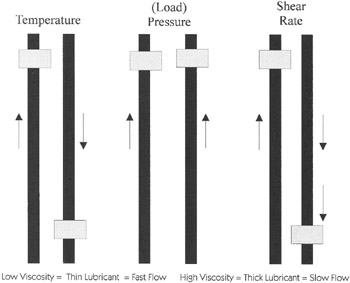
Viscosity of a fluid will change dependent on its temperature, load, and physical state. Viscosity bears a direct relation to the lubricant s film strength and ability to keep moving parts separated. Low viscosity oil presents itself as a thin lubricant and flows very easily. On the other hand, high viscosity lubricant presents itself as a thick lubricant and does not flow as easily. Because oil is designed to keep two moving surfaces fully separated, the viscosity is chosen based on the load and working temperature of the application. Thick oil designed for large bevel gears would cause viscous drag and high fluid friction within a hydraulic system. Conversely, thin hydraulic oil used in a steel mill gearbox would never have enough body to achieve full film separation. Figure 4.3a shows how change in state can affect viscosity. If an application involves high speeds, low loads and low temperatures, then a low viscosity or thin lubricant is adequate. Inversely, if low speeds, high load and high temperature were the given, then high viscosity or a thick lubricant should be chosen.
In choosing lubricants, we must ensure the viscosity is high enough to provide a continuous oil film in the contact area, but not too high so as to create fluid friction due to VISCOUS...