Lubrication for Industry, Second Edition

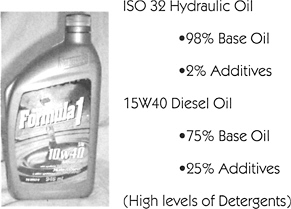
Lubricants are complex materials formulated from high quality hydrocarbon or synthetic oil base stocks to which are added numerous supplemental materials that give each lubricant its unique performance signature. The lubricant family classification may call it an ISO 220 gear oil, but each lubricant company s version of this oil will be formulated differently to achieve a similar end result, much like GM or Ford s version of a compact car similar in class but two different approaches to achieve the end result. Figure 4.7a shows pictorially the ratio of base oil to additive for various oils.
Additives are blended with the petroleum or synthetic base stocks to strengthen or modify the lubricant s characteristics, this allows the modified lubricant to meet much higher demands and specification requirements. Poor lubricant base stock can be made to meet specification with additive package
The most common additives found in lubricating oil are:
| ADDITIVES | Engine Oils | ATF | General R&O Oil | AW Hydraulic | Industrial Gcar Oil | Automotive Gear Oil | Grease |
|---|---|---|---|---|---|---|---|
| Defergents | | | |||||
| Dispersants | | | |||||
| Anti-Oxidants | | | | | | | |
| Rust Inhibitors | | | | | | | |
| Anti-Wear | | | | | | | |
| E.P. Agents | | | |||||
| VI Improvers | | | HVI | SOME | SOME | ||
| Pour Point Depressants | | | | | | | |
| Anti-Foam | | | | | | | |
| Dyes | | | |||||
| Friction Modifiers | | |
Dispersant These materials chemically react with the non-desirable oxidation products and enable the oil to suspend dirt particles...