Lubrication for Industry, Second Edition

4.4: Viscosity Index VI

4.4 Viscosity Index VI

Viscosity Index or V.I. is the rate of change in viscosity due to the change in temperature.

The higher the V.I. of an oil, the less the tendency for its viscosity or thickness to change with changes of temperature. Synthetic oils tend to have a better viscosity index than petroleum based stocks.

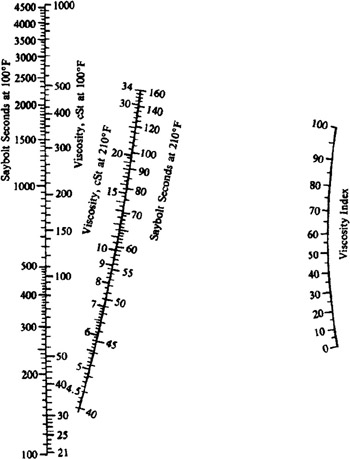
If two lubricating oils are being consided, all things being equal, the lubricant with the higher V.I. would be the lubricant of choice. See Figure 4.4.


Figure 4.4: Determining Viscosity Index (V.I.) ASTM D-2270

When viscosity at two temperatures is known, (100 F and 210 F) locate as points on the corresponding lines. Place a straight edge across these two points and the intersecting Viscosity Index line. Read the value at the point of intersection for the correct V.I.

If viscosity at one temperature and a desired V.I. are known, locate their respective points with a straight edge and read the viscosity reading at the second temperature line to determine the necessary viscosity needed to achieve the required V.I.

Rule of thumb The service life of petroleum based oil is specified as:

  • 30 years @ 85 F (30 C)

  • 15 years @ 104 F (40 C)

  • 3 months @ 212 F (100 C)

For every 18 F (10 C) oil temperature increase, the lubricant s effective life is halved.

These figures are oil industry figures for guideline purposes. Other service factors should be considered when using this service life guideline.

UNLIMITED FREE
ACCESS
TO THE WORLD'S BEST IDEAS

SUBMIT
Already a GlobalSpec user? Log in.

This is embarrasing...

An error occurred while processing the form. Please try again in a few minutes.

Customize Your GlobalSpec Experience

Category: Industrial Lubricants
Finish!
Privacy Policy

This is embarrasing...

An error occurred while processing the form. Please try again in a few minutes.