1.1 DETERMINANTS AND ELEMENTARY PROPERTIES
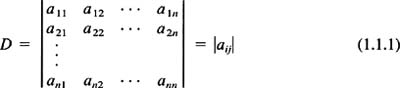
A determinant of nth order is written in the form
and is a square array of n 2 elements a ij, which may be real or complex numbers or functions. In the general element a ij, i refers to the row number and j to the column number where the element is located.
The determinant is essentially a number or a function; it is defined as
where the summation is over all possible products of a ij, each involving n elements, one and only one from each row and each column. Thus there exist n choices for the first element, ( n ? 1) choices for the second element, and so on.
For a particular determinant, there are n! terms in the sum. In each term, the second subscripts j in a ij will initially not be in the natural order 1, 2, 3, , n, although all numbers from 1 to n will appear. The value of h is defined as the number of transpositions required to transform the sequence l 1, l 2, , l n into the order 1, 2, 3, , n, where a transposition is an interchange of two numbers l k and l m.
The number h is not unique, but it can be shown to be always either...


 TABLE OF CONTENTS