2.4 CONTINUOUS DEPENDENCE ON A PARAMETER OR THE INITIAL CONDITION
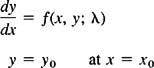
It should be evident that if in place of the ODE (2.2.1) with the IC (2.2.2), we consider the problem
where ? is a parameter, the existence and uniqueness of the solution is again guaranteed as long as f is Lipschitz continuous in the variable y. We now show that besides these properties ensured for fixed values of ? and y 0, the solution possesses the additional feature of being continuously dependent on the parameter ? and the initial value y 0.
For this, consider the two problems
where f satisfies a Lipschitz condition in y:
Then eq. (2.2.4) applied to eqs. (2.4.1) and (2.4.2) leads to
and
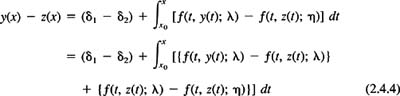
Subtracting gives
We again need to consider separately the regions x > x 0 and x < x 0. For x > x 0, we obtain
Let us assume that the function f depends continuously on the parameter. Thus
where ? is small if ? ? ? is small. With this and eq. (2.4.3), we have
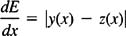
Let us denote
Then
and (2.4.6) becomes the differential inequality
with the IC
by definition of E, and p( x) > 0.
Following the same approach employed in section 2.2, while solving for ?( x) defined by eq. (2.2.18), we obtain
Differentiating both sides with respect to x gives
Since p


 TABLE OF CONTENTS