2.1 SOME ELEMENTARY IDEAS
For a first-order ordinary differential equation (ODE) of the type
with a prescribed initial condition (IC)
where f( x, y) is a nonlinear function of x and y, it is in general not possible to solve for y analytically. This is in contrast to linear ODEs, such as
with IC
which can be solved readily by using the familiar integrating factor approach, to yield
It is straightforward to verify that eq. (2.1.5) is indeed the solution of the ODE (2.1.3) which satisfies the IC (2.1.4).
A nonlinear ODE can be solved analytically only for certain special cases. One such case is that of a separable equation:
where the solution follows by separating the variables x and y and then integrating.
A second case involves the so-called exact equations, which can be written in the form
The solution is given by
where c is an arbitrary constant. In order for an ODE to be described by the form (2.1.7), we require that the functions P and Q satisfy the condition derived below. From the first of eqs. (2.1.7), we have
while the second leads to
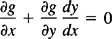
which rearranges as
Comparing eqs. (2.1.9) and (2.1.10), we obtain
the condition for eq. (2.1.7) to be exact. Also, a comparison of eqs. (2.1.6), (2.1.9), and (2.1.10) leads to the conclusion that a separable equation is simply a special case of an exact equation.
The final category...


 TABLE OF CONTENTS