Mathematical Methods in Chemical Engineering

2.2: EXISTENCE AND UNIQUENESS THEOREM FOR A SINGLE FIRST-ORDER NONLINEAR ODE

2.2 EXISTENCE AND UNIQUENESS THEOREM FOR A SINGLE FIRST-ORDER NONLINEAR ODE

In considering the solutions of the nonlinear ODE


with IC


the following result can be proven (cf. Ince, 1956, chapter 3; Coddington, 1989, chapter 5).

Theorem

Let f(x, y) be a one-valued, continuous function of x and y in a domain defined as


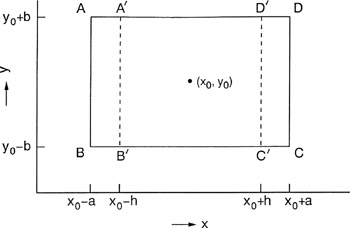
and shown as the rectangle ABCD in Figure 2.1.


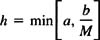
Figure 2.1: Definition of domain for a case where h = b/ M < a.

Let f( x,y) ? M in , and let


If h < a, then is redefined as


and shown as the rectangle A'B'C'D' in Figure 2.1. Furthermore, let f( x, y) satisfy the Lipschitz condition, which implies that if ( x, y) and ( x, Y) are two points in , then


where K is a positive constant.

With these conditions satisfied, the existence theorem ensures that there exists a unique continuous function of x, say y( x), defined for all x in the range x ? x 0 ? h, which satisfies the ODE


and the IC


The theorem can be proved in more ways than one. The most common proof is by a method of successive approximations, also called Picard iteration. The proof derives from the fact that integrating both sides of eq. (2.2.1) with...

UNLIMITED FREE
ACCESS
TO THE WORLD'S BEST IDEAS

SUBMIT
Already a GlobalSpec user? Log in.

This is embarrasing...

An error occurred while processing the form. Please try again in a few minutes.

Customize Your GlobalSpec Experience

Category: Industrial Valves
Finish!
Privacy Policy

This is embarrasing...

An error occurred while processing the form. Please try again in a few minutes.