2.3 SOME REMARKS CONCERNING THE EXISTENCE AND UNIQUENESS THEOREM
The two main assumptions in the theorem are that the function f( x, y) is continuous and that it satisfies the Lipschitz condition in the domain  . These two assumptions are indepenent of each other. Thus a function may be continuous but may not satisfy the Lipschitz condition [e.g., f( x, y) = y 1/2 for any
  that contains y = 0]. Alternatively, it may be discontinuous and yet be Lipschitzian (e.g., a step function). We now examine the necessity of these two assumptions.
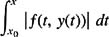
It should be apparent from the proof of the theorem that the continuity of f( x, y) is not required. All the arguments in the proof remain valid if f( x, y) is merely bounded, such that the integral
exists. Thus f( x, y) may well possess a finite number of discontinuities, and yet the solution y( x) remains continuous.
Consider, for example, the initial value problem:
with the IC
where
is discontinuous at x = 0. However, the solution is continuous:
and is shown in Figure 2.2. Note that although y( x) is continuous, it does not have a continuous derivative at x = 0 as implied by the discontinuity in f( x, y).
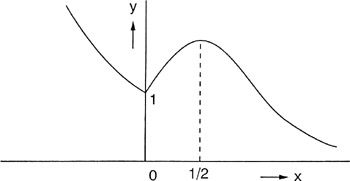 Figure 2.2: The solution y( x) given by eq. (2.3.4).
 The Lipschitz condition, on the other...


 TABLE OF CONTENTS