Mathematics for Business, Science and Technology: With MATLAB and Spreadsheet Applications, Second Edition
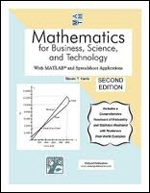
This chapter is a review of the basic arithmetic concepts. It is intended for readers feeling that they need a math review from the very beginning. It forms the basis for understanding and working with relations (formulas) encountered in business, science and technology. Readers with a fair mathematical background may skip this chapter. Others may find it useful as well as a convenient source for review.
The decimal ( base 10) number system uses the digits (numbers) 0, 1, 2, 3, 4, 5, 6, 7, 8, and 9. This is the number system we use in our everyday arithmetic calculations such as the monetary transactions. Another number system is the binary ( base 2) that uses the digits 0 and 1 only. The binary system is used in computers and it is being taught in electronics courses. We will not be concerned with the binary system in this text.
A positive number is a number greater than zero and it is understood to have a plus (+) sign in front of it. The (+) sign in front of a positive number is generally omitted. Thus, any number without a sign in front of it is understood to be a positive number. A negative number is less than zero and it is written with a minus ( ?) sign [*] in front of it. The minus ( ?) sign...