This chapter is a continuation of the previous chapter. It discusses several probability distributions, percentiles, Chebyshev's inequality, law of large numbers, sampling distribution of means, tests of hypotheses, levels of significance, and the z, t, F, and ? 2(chi-square) tests.
11.1 Properties of Binomial Coefficients
The notation
where n represents the number of trials in an experiment, and k the probability that an event will occur, is used extensively in probability theory.
For k = 0, 1, 2, and 3 and making use of 0! = 1 [*], we get
and if a + b = n
and therefore,
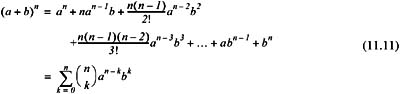
The relation
is known as the binomial expansion [*], binomial theorem, or binomial series.
[*]By definition of the factorial, n! = n ( n ? 1) ( n ? 2) 1. Therefore, ( n + 1)! = ( n + 1) n! and for n = 0, the last expression reduces to 1! = 1 0! and thus 0! = 1.
[*]The expansion of ( a + b) n contains n + 1 terms. Formulated in medieval times, the binomial theorem was developed (about 1676) for fractional exponents by the English scientist Sir Isaac Newton, enabling him to apply his newly discovered methods of calculus to many difficult problems. The...
Copyright Orchard Publications 2003 under license agreement with Books24x7

 TABLE OF CONTENTS