Mathematics for Business, Science and Technology: With MATLAB and Spreadsheet Applications, Second Edition
Let X be an rv (continuous or discrete) with mean ? and variance ? 2. Chebyshev's inequality states that
That is, the probability of X differing from its mean by more than some positive number ?, is less than or equal to the ratio of the variance ? 2 to the square of the number ?. This inequality is often expressed as
where and ? = k ? and k > 1.
If, in (11.109), we let k = 2, we get
and this implies that the probability of X differing from its mean by more than two standard deviations, is less than or equal to 0.25. That is, the probability that X will lie within two standard deviations of its mean is greater or equal to 0.75 since
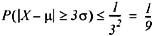
Likewise, if k = 3,
or
that is, at least 8/ 9 or 89% of the data will fall between ? ? 3 ? and ? + 3 ?.