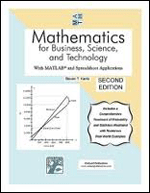
Mathematics for Business, Science and Technology: With MATLAB and Spreadsheet Applications, Second Edition
Chapter 10: Random Variables

This chapter defines discrete and continuous random variables, the cumulative distribution function, the probability density function, and their properties. Statistical averages, moments, and characteristic functions are also discussed. Some sections presume knowledge of advanced mathematics; these may be skipped without loss of continuity.

10.1 Definition of Random Variables

We may associate an experiment and its possible outcomes with a space and its points. Then, we may associate a point called the sample point s i with each possible outcome of the experiment.

The total number of sample points { s}, corresponding to the aggregate of all possible outcomes of the experiment, is called the sample space.

An event may correspond to a single sample point or a set of sample points. For example, in an experiment involving the throw of a die, there are six possible outcomes { 1, 2, , 6}. By assigning a sample point to each of these possible outcomes we get a sample space that consists of six sample points. Thus a "five" corresponds to a single sample point. Also, if we choose an even number to represent a sample point, then the sample space consists of three sample points, that is, { 2, 4, 6}.

Now, suppose that the outcome is a variable that can wander over the set of sample points, and whose value is determined by the experiment. Then, a function whose domain is a sample space and whose...

UNLIMITED FREE
ACCESS
TO THE WORLD'S BEST IDEAS

SUBMIT
Already a GlobalSpec user? Log in.

This is embarrasing...

An error occurred while processing the form. Please try again in a few minutes.

Customize Your GlobalSpec Experience

Category: Color Meters and Appearance Instruments
Finish!
Privacy Policy

This is embarrasing...

An error occurred while processing the form. Please try again in a few minutes.