Maxwell’s Equations and the Principles of Electromagnetism
Chapter 7: Magnetic Induction

7.1 INTRODUCTION

In this chapter, we shall use Maxwell's equations to investigate magnetic induction and related phenomena.

7.2 INDUCTANCE

We have already learned about the concepts of voltage, resistance, and capacitance. Let us now investigate the concept of inductance. Electrical engineers like to reduce all pieces of electrical circuitary to an equivalent circuit consisting of pure voltage sources, pure inductors, pure capacitors, and pure resistors. Hence, once we understand inductors, we shall be ready to apply the laws of electromagnetism to general electrical circuits.

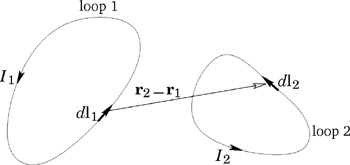
Consider two stationary loops of wire, labeled 1 and 2 see Figure 7.1. Let us run a steady current I 1 around the first loop to produce a magnetic field B 1. Some of the field-lines of B 1 will pass through the second loop. Let ? 2 be the flux of B 1 through loop 2,


Figure 7.1: Two current-carrying loops.

where d S 2 is a surface element of loop 2. This flux is generally quite difficult to calculate exactly (unless the two loops have a particularly simple geometry). However, we can infer from the Biot-Savart law,


that the magnitude of B 1 is proportional to the current I 1. This is ultimately a consequence of the linearity of Maxwell's equations. Here, d l 1 is a line element of loop 1 located at position vector r 1. It follows that the flux ? 2 must also be proportional to I 1

UNLIMITED FREE
ACCESS
TO THE WORLD'S BEST IDEAS

SUBMIT
Already a GlobalSpec user? Log in.

This is embarrasing...

An error occurred while processing the form. Please try again in a few minutes.

Customize Your GlobalSpec Experience

Category: Loop Powered Devices
Finish!
Privacy Policy

This is embarrasing...

An error occurred while processing the form. Please try again in a few minutes.