8.2 ENERGY CONSERVATION
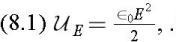
We have seen that the energy density of an electric field is given by [see Equation (5.20)]
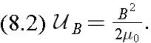
whereas the energy density of a magnetic field satisfies [see Equation (7.55)]
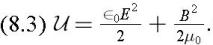
This suggests that the energy density of a general electromagnetic field is
We are now in a position to demonstrate that the classical theory of electromagnetism conserves energy. We have already come across one conservation law in electromagnetism: i.e.,
This is the equation of charge conservation. Integrating over some volume V, bounded by a surface S, and making use of Gauss' theorem,
we obtain
In other words, the rate of decrease of the charge contained in volume V equals the net flux of charge across surface S. This suggests that an energy conservation law for electromagnetism should have the form
Here,  is the energy density of the electromagnetic field, and u is the flux of electromagnetic energy ( i.e., energy u per unit time, per unit cross-sectional area, passes a given point in the direction of u). According to the above equation, the rate of decrease of the electromagnetic energy in volume V equals the net flux of electromagnetic energy across surface S.
However, Equation (8.6) is incomplete, because electromagnetic fields can gain or lose energy by interacting with matter. We need to factor this into our analysis. We saw earlier (see Section 5.3) that the...

 TABLE OF CONTENTS