10.3 THE LORENTZ TRANSFORMATION
Consider two Cartesian frames S(x,y,z,t) and S'[x',y',z',t') in the standard configuration, in which S' moves in the x-direction of S with uniform velocity ?, and the corresponding axes of S and S' remain parallel throughout the motion, having coincided at t = t' = 0. It is assumed that the same units of distance and time are adopted in both frames. Suppose that an event (e.g., the flashing of a lightbulb, or the collision of two point particles) has coordinates (x, y, z, t) relative to S, and (x', y', z', t') relative to S'. The "common sense" relationship between these two sets of coordinates is given by the Galilean transformation:

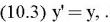
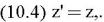

This transformation is tried and tested, and provides a very accurate description of our everyday experience. Nevertheless, it must be wrong! Consider a light wave which propagates along the x-axis in S with velocity c. According to the Galilean transformation, the apparent speed of propagation in S' is c ? ?, which violates the Relativity Principle. Can we construct a new transformation which makes the velocity of light invariant between different inertial frames, in accordance with the Relativity Principle, but reduces to the Galilean transformation at low velocities, in accordance with our everyday experience?
Consider an event P, and a neighboring event Q, whose coordinates differ by dx, dy, dz, dt in S, and by dx', dy', dz', dt' in S'. Suppose that at the event P a flash...

 TABLE OF CONTENTS