In 1960 physicists throughout the world adopted the so-called SI (short for the Systeme International) system of units, whose standard measures of length, mass, time, and electric charge are the meter, kilogram, second, and coloumb, respectively. Nowadays, the SI system is employed, almost exclusively, in most areas of Physics. In fact, only one area of Physics has proved at all resistant to the adoption of SI units, and that, unfortunately, is Electromagnetism, where the previous system of units, the so-called Gaussian system, is still widely used. Incidentally, the standard units of length, mass, time, and electric charge in the Gaussian system are the centimeter, gram, second, and statcoloumb, respectively.
Why would anyone wish to adopt a different set units in Electro-magnetism to that used in most other branches of Physics? The answer is that the laws of Electromagnetism look a lot prettier in the Gaussian system than in the SI system. In particular, there are no ? 0 s and ?? 0 s in any of the formulae. In fact, within the Gaussian system, the only normalizing constant appearing in Maxwell's equations is the velocity of light in vacuum, c. However, there is a severe price to pay for the aesthetic advantages of the Gaussian system.
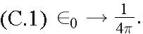
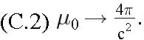
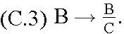
Electromagnetic formulae can be converted from the SI to the Gaussian system via the following transformations
Transformation (C.3) also applies to quantities which are directly related to magnetic field-strength, such as vector potential. Converting electromagnetic formulae from the Gaussian to...
Copyright INFINITY SCIENCE PRESS LLC 2008 under license agreement with Books24x7

 TABLE OF CONTENTS