Maxwell’s Equations and the Principles of Electromagnetism
Chapter 9: Electromagnetic Radiation

9.1 INTRODUCTION

In this chapter, we shall employ Maxwell's equations to investigate the emission, scattering, propagation, absorption, reflection, and refraction of electromagnetic radiation.

9.2 THE HERTZIAN DIPOLE

Consider two small spherical conductors connected by a wire. Suppose that electric charge flows periodically back and forth between the spheres. Let q (t) be the instantaneous charge on one of the conductors. The system is assumed to have zero net charge, so that the charge on the other conductor is ?q(t). Finally, let


Now, we expect the oscillating current flowing in the wire connecting the two spheres to generate electromagnetic radiation (see Section 4.11). Let us consider the simple case in which the length of the wire is small compared to the wavelength of the emitted radiation. If this is the case then the current I flowing between the conductors has the same phase along the whole length of the wire. It follows that


where I 0 = ? q 0. This type of antenna is called a Hertzian dipole, after the German physicist Heinrich Hertz.

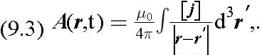
The magnetic vector potential generated by a current distribution j(r) is given by the well-known formula (see Section 4.12)


where


Suppose that the wire is aligned along the z-axis, and extends from z = ?l/2 to z = l/2. For a wire of negligible thickness, we can replace j( r ?,t ?r ? r ?/c) d 3r ? by I(r

UNLIMITED FREE
ACCESS
TO THE WORLD'S BEST IDEAS

SUBMIT
Already a GlobalSpec user? Log in.

This is embarrasing...

An error occurred while processing the form. Please try again in a few minutes.

Customize Your GlobalSpec Experience

Category: Multiconductor Cables
Finish!
Privacy Policy

This is embarrasing...

An error occurred while processing the form. Please try again in a few minutes.