Maxwell’s Equations and the Principles of Electromagnetism
10.8: PROPER TIME

10.8 PROPER TIME

It is often helpful to write the invariant differential interval ds 2 in the form


The quantity d ? is called the proper time. It follows that


Consider a series of events on the world-line of some material particle. If the particle has speed u then


implying that


It is clear that d ? = d ? in the particle's rest frame. Thus, d ? corresponds to the time difference between two neighboring events on the particle's world-line, as measured by a clock attached to the particle (hence, the name proper time). According to Equation (10.100), the particle's clock appears to run slow, by a factor ?(u), in an inertial frame in which the particle is moving with velocity u. This is the celebrated time dilation effect.

Let us consider how a small 4-dimensional volume element in space-time transforms under a general Lorentz transformation. We have


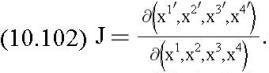
where


is the Jacobian of the transformation: i.e., the determinant of the transformation matrix p ?. A general Lorentz transformation is made up of a standard Lorentz transformation plus a displacement and a rotation. Thus, the transformation matrix is the product of that for a standard Lorentz transformation, a translation, and a rotation. It follows that the Jacobian of a general Lorentz transformation is the product of that for a standard Lorentz transformation, a translation, and a rotation. It is well-known that the Jacobian of the latter two transformations...

UNLIMITED FREE
ACCESS
TO THE WORLD'S BEST IDEAS

SUBMIT
Already a GlobalSpec user? Log in.

This is embarrasing...

An error occurred while processing the form. Please try again in a few minutes.

Customize Your GlobalSpec Experience

Category: HEPA Filters and ULPA Filters
Finish!
Privacy Policy

This is embarrasing...

An error occurred while processing the form. Please try again in a few minutes.