Mechanical Efficiency of Heat Engines

Chapter 1: Energy Transfers in Cyclic Heat Engines

Heat engines are made to provide mechanical energy from thermal energy. Efficiency is a convenient measure of how well this is done. The overall efficiency of an engine is usually thought of as the product of two more basic efficiencies: the thermal efficiency of the engine cycle and the cyclic mechanical efficiency of the complete device. The first is well treated in classical thermodynamics. The second, mechanical efficiency, is the subject of this work.

Analysis of the mechanical efficiency of heat engines can be only as general as the conceptual basis on which it is built. The model used here has a level of generality matching that used in classical thermodynamics to analyze the thermal efficiency of heat engines.

HEAT ENGINE DIAGRAMS

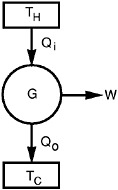
Figure 1.1 is a representation of a cyclic heat engine typically found in thermodynamics textbooks. G represents the body of the working substance, and T H and T C are the temperatures of the heat source and sink, respectively. The net or indicated cyclic work done by the engine working substance is the difference Q i ? Q o = W between the heat absorbed from the high temperature source and the heat rejected to the lower temperature reservoir during a complete cycle.


Figure 1.1: Cyclic heat engine diagram depicting heat transfers Q i and Q o to and from the working substance and indicated work output W.

Although the diagram is adequate for discussing the thermal efficiency ? t

UNLIMITED FREE
ACCESS
TO THE WORLD'S BEST IDEAS

SUBMIT
Already a GlobalSpec user? Log in.

This is embarrasing...

An error occurred while processing the form. Please try again in a few minutes.

Customize Your GlobalSpec Experience

Category: Combustion Engines
Finish!
Privacy Policy

This is embarrasing...

An error occurred while processing the form. Please try again in a few minutes.