Mechanical Efficiency of Heat Engines

In this chapter, previous results are applied to deduce general upper bounds on the performance of large classes of engines characterized by a few simple parameters. The following theorem, which is a consequence of Inequality (2.4), is the main tool used (Senft, 1985, 1987a).
If the effectiveness ? of an engine mechanism is bounded above by the constant 0 < E ? 1, that is, if ? ? E throughout the cycle, then the mechanical efficiency ? m of the engine satisfies
where W is the indicated work of the cycle and W ? is the forced work. Equality holds in (3.1) if the mechanism effectiveness equals the constant E over the entire cycle and buffer pressure is constant.
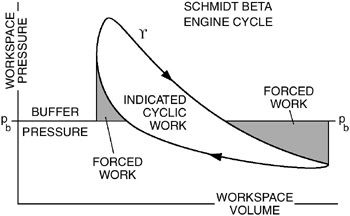
The straightforward use of this theorem is to obtain an upper estimate on the mechanical efficiency of a proposed engine. For example, the engine cycle of Figure 3.1 is that of a beta type Stirling engine analytically obtained by use of the well-known Schmidt model (Senft, 2000). For the buffer pressure shown, the forced-to-indicated work ratio is about 0 .30 = W ? /W. If it were estimated or analytically determined that the engine mechanism had an effectiveness of 90% or less, then the theorem would show that the mechanical efficiency of the engine could not exceed 84%:
This is a substantial...