The following derivation supplies the equations needed for Chapter 10 and follows the nomenclature described there.
VOLUME AND PRESSURE FUNCTIONS
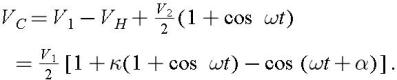
The instantaneous volume of gas in the hot and cold spaces of the engine are
and
The instantaneous total engine volume V is then
In terms of the total swept volume V T = V 1 + V 2 = V 1(1 + ?) of the piston and displacer,
By the assumptions made, instantaneous pressure within the engine is
where m is the total mass of gas captive within the engine and R is its ideal gas constant. Putting the expressions obtained above for V H and V C in the denominator of the last expression gives the following expression for the instantaneous pressure:
The factor in the brackets in the denominator can be written in the following form:
where
Let
The analysis is limited to ? in the range 0 < ? < ?. Then B > 0, and A is positive or negative according to whether ?/(1 ? ?) > cos ? or not. Corresponding to whether A is positive or negative, ? will be in Quadrant I or II. With ? thus defined,
where
Therefore,
It is easily seen then that
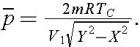
Then the root mean cycle pressure  can be written as
It can be checked that this is the exact same expression that...


 TABLE OF CONTENTS