Mechanical Efficiency of Heat Engines

Chapter 9: Multi-Workspace Engines and Heat Pumps

This chapter shows how the previous results can be extended to apply to engines having more than one workspace and also to heat pumps.

MULTI-CYLINDER ENGINES

Most multi-cylinder engines consist of a number of identical single-piston units connected to a common shaft. This is the case, for example, with in-line and v arrangements in internal combustion engines and wobble-plate Stirling engines. The individual units usually have identical mechanisms, share a common constant buffer pressure, and have the same pressure volume cycles on the piston working faces. The units are usually connected to the common shaft with offset phasing to smooth out the working of the composite machine. For this kind of uniform parallel connection, the mechanical efficiency is obviously the same as that of the individual units.

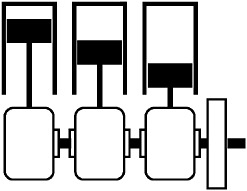
In a more general case, the cycles and mechanisms may be differ-ent. Consider a parallel connection as in Figure 9.1 with n units, each having a cycle and a mechanism effectiveness at most equal to the constant E i between 0 and 1 over its respective cycle. Inequality (2.2) applies to each unit, that is,


Figure 9.1: A parallel connection of three single-workspace engines.

where the efficacious and forced works W + and W ? are defined as before by (8.6) and (8.7). Taking the sum of inequalities (9.1) yields


Let E = max { E i}. Then the total net shaft output is bounded above as follows:


The case of constant buffer pressure is of most applicability for...

UNLIMITED FREE
ACCESS
TO THE WORLD'S BEST IDEAS

SUBMIT
Already a GlobalSpec user? Log in.

This is embarrasing...

An error occurred while processing the form. Please try again in a few minutes.

Customize Your GlobalSpec Experience

Category: Combustion Engines
Finish!
Privacy Policy

This is embarrasing...

An error occurred while processing the form. Please try again in a few minutes.