Mechanical Efficiency of Heat Engines

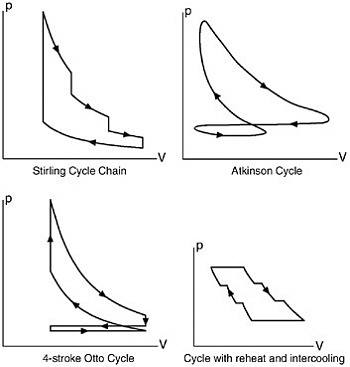
Previous chapters covered engines with p-V cycles that could be described by two continuous pressure functions p e( V) ? p c( V) over the interval [ V m, V M] of volume variation of the engine. Such cycles were termed regular. Regularity is not an overly restrictive limitation, but some engine cycles are not that simple. Figure 8.1 shows examples of non-regular cycles having intermediate constant volume processes, pumping loops, and multiple strokes or volume reversals.
A general engine cycle can be mathematically described as a continuous piecewise smooth closed curve in the V-p plane, that is, a closed curve that is the union of a finite number of endpoint-connected smooth curves (Buck, 1965). Such curves can be described parametrically as
where J is a closed bounded interval of length equal to the least common period of the functions ? and ?. In this setting of course, V and p are positive at all times. The indicated cyclic work of the engine is by definition
For regular engine cycles, the indicated work is simply the area inside the cycle. For general cycles, areas enclosed by the cycle that are bounded by a counterclockwise-oriented subcycle are to be subtracted from the subcycle areas with a clockwise boundary. Thus, in the Atkinson cycle shown in Figure 8.1, the area within the small pumping subcycle is to be...