Mechanical Efficiency of Heat Engines

Appendix A: General Theory of Machines, Effectiveness, and Efficiency

In this section an analytical basis for machines is developed which may be applied as a general mathematical model of the mechanical section of an engine. A universal definition of mechanism effectiveness is given. A formula is derived expressing output work in terms of input work and effectiveness.

KINEMATIC MACHINES

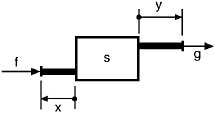
The simplest machine is one having two actuators by which it interacts with external agents; Figure A.1 is a schematic representation. Each actuator is a device capable of linear or angular motion, but not both, and of accepting or applying a force or torque, respectively. One dimensional coordinate systems x and y are assigned to the range of motion of each actuator.


Figure A.1: Schematic representation of a two-actuator machine.

STATE PARAMETER

In kinematic machines, the connection between the actuators is most conveniently represented by a single parameter, usually s, which also serves to specify the position of all the elements of the machine. Accordingly, it is referred to as the state parameter of the machine. Often the state parameter can be taken to be one of the actuator positions. For example, s may be taken to be the crank angle in the analysis of a two-stroke internal combustion engine. For a four-stroke engine, the camshaft angle would be appropriate. In a typical scissors jack, the cumulative screw angle, the linear postion of the nut block, or even the angle of one of the scissor arms would make an acceptable state parameter since each of...

UNLIMITED FREE
ACCESS
TO THE WORLD'S BEST IDEAS

SUBMIT
Already a GlobalSpec user? Log in.

This is embarrasing...

An error occurred while processing the form. Please try again in a few minutes.

Customize Your GlobalSpec Experience

Category: Valve Actuators
Finish!
Privacy Policy

This is embarrasing...

An error occurred while processing the form. Please try again in a few minutes.