Metal Forming Practise: Processes - Machines - Tools
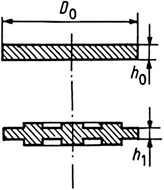
Coining is a cold forming process where certain surface forms are produced with low material displacement.
In coining the thickness of the material in the starting stock is altered.
Application:
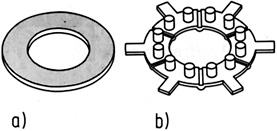
Coin production (Figure 8.1), indenting impressions into badges, coining components for mechanical engineering and the electrical engineering industry (Figure 8.2).
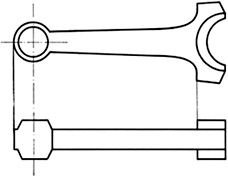
This is used to give higher dimensional accuracy to a blank which has already been pre-formed. For example, drop forged connecting rods (Figure 8.3) can be given higher dimensional precision by sizing the thickness of the hub and the spacing of the hub centres.
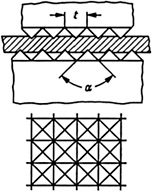
This is used to straighten twisted or warped stamped parts.
By stamping a grid pattern (Figure 8.4) (rough straightening) stresses can be relieved and the parts straightened out.
In force calculation a difference is made between embossing and impressing lettering, and deep coining. In deep coining, the depth of the relief, and thus also the deformation stress, k r, (Table 8.1) is greater than when embossing.
| Material | R m in N/mm 2 | k r in N/mm 2 |
|---|